
Avocado Oil vs Olive Oil: Which is Better and Safer for Healthy Cooking?
 Is avocado oil better than olive oil for cooking in your kitchen? And should you even be frying with extra virgin olive oil or can this be harmful?
Here are the key differences between olive oil and avocado oil and which one is better and safer for cooking.
What is Avocado Oil?
Similar to olive oil, avocado oil is one of the few cooking oils extracted directly from the fruit rather than chemically extracted from seeds. Avocados have the highest fat content of any fruit. These fats are cold pressed out of the fruit pulp in a similar way to the method used to produce extra virgin olive oils.
The resulting oil is rich in beneficial monounsaturated fats and has good levels of antioxidants and other healthy compounds. Avocado oil also has a particularly high smoke point that makes it a great choice for frying with.
In all of these ways, a high quality cold pressed and organic oil made from avocados is superior to the more commonly used olive oil. Here’s why.
Extra Virgin Olive Oil Compared to Avocado Oil — Which is Safer?
Cold pressed avocado oil has a strong claim as the best cooking oil to use in your kitchen, especially compared to olive oil.
It has a very high smoke point, generally listed as between 480 Fahrenheit and 520 Fahrenheit (248 – 270 Celsius). This makes it a great choice for stir-frys, grilling, roasting, frying and other high temperature cooking.
By comparison, extra virgin olive oil has a much lower smoke point of between 350 Fahrenheit and 383 Fahrenheit (176 – 195 Celsius). This makes it unsuitable for high heat frying.
Lower quality ‘light’ olive oil has a smoke point of around 430 Fahrenheit (220 Celsius), which may okay for frying on medium heat. Unrefined avocado oil is much better for you nutritionally than heat extracted oils though.
It’s important to avoid having whatever cooking oil you are using smoking heavily in the pan. At that point, any health benefits the oil used to contain are gone and there’s a good chance dangerous compounds have been created.
Read more about the problems with the smoke point of cooking oils here.
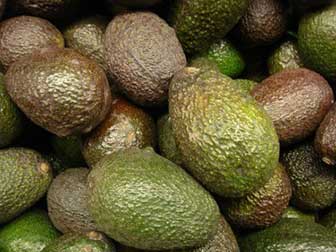
Fat Comparison
Cold pressing extraction produces high quality and great tasting oil from avocados, with very low acidity and many beneficial properties. Foremost of these are high levels of monounsaturated fats.
Cold pressed avocado oil is up to 76% monounsaturated fatty acids. This is even higher than olive oil’s at approximately 67%. It also has less saturated fat at 13%, versus 17%.
Monounsaturated fatty acids, from plant sources like avocados and olives, are some of the best dietary fats for improving circulatory wellbeing.
Oleic acid and other omega-9 fats are also important for maintaining good moisture levels within your skin’s epidermal layer.
If your skin is feeling dry and looking tired, switching to cooking with avocado oil may help to improve your complexion.
There’s a much faster way to improve your skin tone though — by using it as a face moisturizer.
Vitamin E Levels
Natural vitamin E is a potent antioxidant for combating free radical damage. It’s also beneficial for skin health and healing.
Cold pressed and unrefined avocado oil has high levels of alpha and gamma tocopherol. Extra virgin olive oil is also rich in vitamin E, though amounts can vary greatly depending on processing and growing region.
Higher Phytosterols
Phytosterols are beneficial compounds found in both of these culinary oils that may reduce cholesterol absorption during digestion.
Cold pressed avocado oil has the phytosterol beta-sitosterol in the highest concentrations. It also contains other phytosterols like campesterol and stigmasterol.
It has around twice the beta-sitosterol of organic olive oil and even more than the highly regarded saw palmetto.
Olive Oil Versus Avocado Oil — The Verdict
There’s many reasons to recommend switching to avocado oil in your kitchen, especially if you are currently frying with extra virgin olive oil at high temperatures. Cooking oils made from cold pressed avocados are clearly superior for this purpose.
Alongside its much higher smoke point, it also has more monounsaturated fats, more antioxidant vitamin E and more beta-sitosterol than olive oil.
Finally, and most importantly for many people, cold pressed and organic avocado oil tastes great with a rich and buttery flavor that’s much nicer than the average olive oil.
All in all, extra virgin olive oil is still very good for you, especially unheated. In many ways though, the lesser known avocado oil is healthier and much better for cooking with.